Loading…

Loading…
The way people discover and interact with businesses is changing quickly across the UAE. Search engines are no longer the only place customers look for information. Social media, short videos, online reviews, maps, AI-powered search, and business websites all influence how people make decisions. At the same time, businesses are using artificial intelligence, automation, customer data, and personalised campaigns to improve their marketing efforts. For UAE businesses, the opportunity is not simply to adopt every new marketing trend. The focus should be on using the right technologies and channels to reach relevant customers, provide useful information, and turn online interactions into meaningful business opportunities.
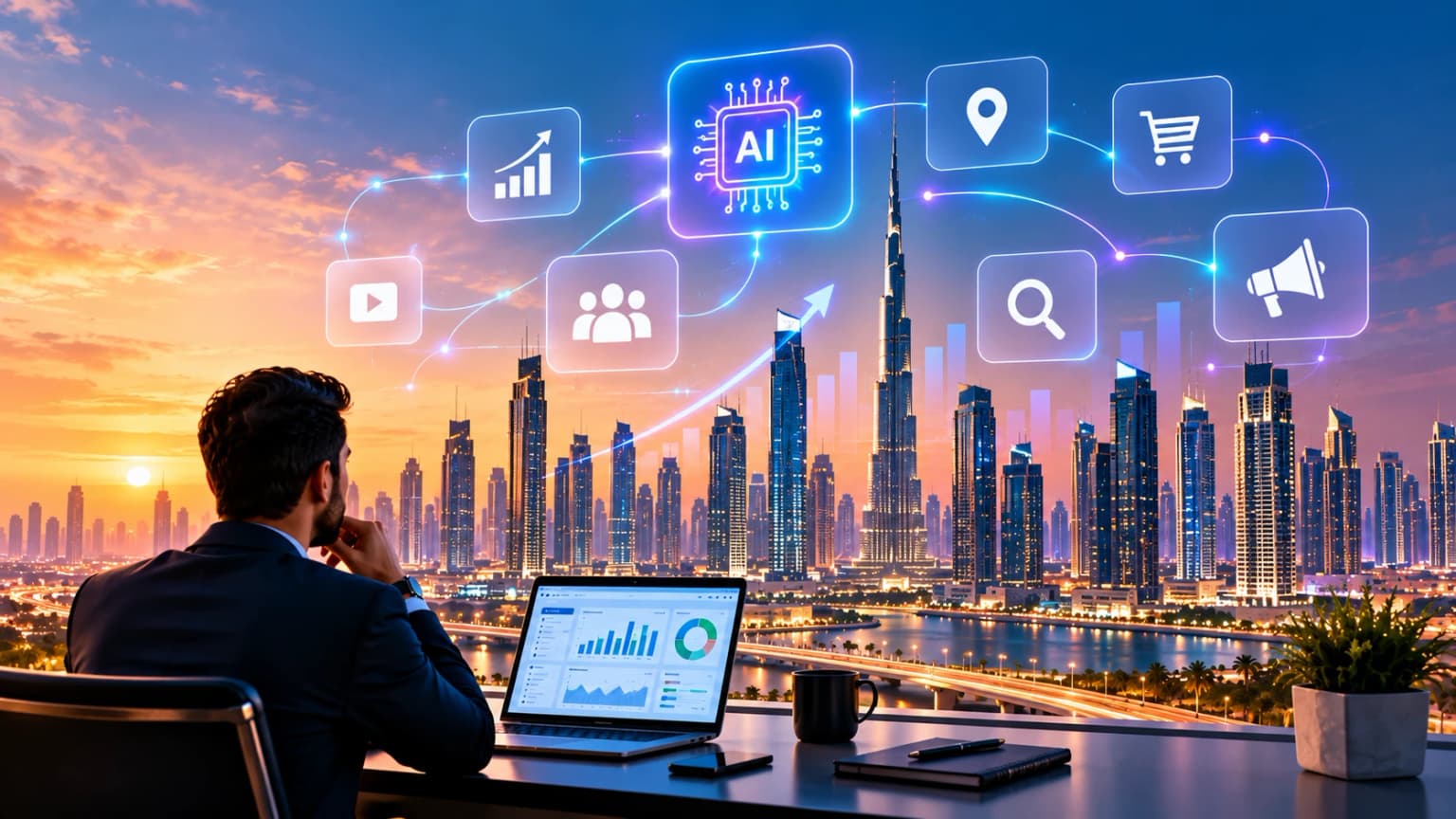
Several developments are influencing the digital marketing environment in 2026:
Artificial intelligence in marketing
Personalised customer experiences
AI-powered search
Answer-focused content
Short-form video
Social commerce
Marketing automation
Local search optimisation
Interactive digital experiences
Data-driven campaign management
These trends are not independent. A business may use AI to understand its audience, create better content, improve advertising, and deliver more relevant experiences across different channels.
AI has moved from being an experimental technology to a practical marketing tool.
Businesses can use AI to analyse customer behaviour, identify audience groups, assist with content creation, study campaign performance, and find patterns within large amounts of data.
For example, an online retailer can analyse browsing behaviour to understand which products interest different customers. A service business can identify common questions from enquiries and use those insights to create useful website content.
However, AI-generated output still needs human review. Brand voice, accuracy, originality, customer expectations, and business context should remain part of the decision-making process.
Customers are more likely to engage with information that is relevant to their needs.
Personalisation allows businesses to adapt messages, offers, recommendations, and content according to customer interests or previous interactions.
A restaurant might promote different offers to different customer groups. A real estate company could present property information based on location or budget preferences. An online store could recommend products related to previous browsing activity.
The objective should be useful personalisation rather than simply collecting more customer data. Businesses also need to handle customer information responsibly and maintain appropriate privacy practices.
Search behaviour is becoming more conversational.
Instead of entering a short phrase, users can ask detailed questions and expect a complete explanation. AI-powered search experiences can also summarise information from several sources before presenting an answer.
This creates a new consideration for businesses. Having a page that simply targets a keyword may not be enough.
Content should clearly explain the subject, answer genuine customer questions, provide supporting information, and demonstrate relevant expertise.
For example, instead of creating a page that only discusses “digital marketing,” a business could explain how digital marketing works for UAE companies, which channels are useful, how campaigns are measured, and what businesses should consider before investing.
Answer Engine Optimisation, commonly referred to as AEO, focuses on making useful information easy to understand and discover when people ask questions.
A simple approach is to answer an important question directly before providing additional context.
For example:
AI-powered digital marketing uses artificial intelligence to analyse information, understand customer behaviour, automate selected marketing activities, and support campaign optimisation.
The rest of the section can then explain practical examples, benefits, limitations, and considerations.
This type of structure helps readers find information quickly while keeping the content informative and useful.
Social platforms have developed beyond simple brand-promotion channels.
Customers can discover a business through a video, read comments or reviews, visit its profile, explore products or services, and eventually make an enquiry or purchase.
This makes social media particularly useful for industries such as restaurants, retail, fashion, hospitality, beauty, and lifestyle businesses.
UAE businesses can experiment with product demonstrations, customer stories, behind-the-scenes videos, educational posts, creator collaborations, and short-form content.
Not every post needs to promote a product directly. Useful and entertaining content can help businesses build familiarity before a customer is ready to take action.
Video allows businesses to communicate information quickly while showing the people, products, and processes behind a brand.
Short videos can answer common questions, demonstrate products, introduce services, or explain simple concepts. Longer videos can provide tutorials, interviews, case studies, and detailed explanations.
For UAE businesses, locally relevant video content can also help establish credibility. Showing actual projects, team members, offices, customer experiences, or service processes can make a brand feel more authentic.
The priority should be clear communication rather than producing videos simply because video is popular.
Marketing teams often spend considerable time handling repetitive activities such as reporting, audience segmentation, follow-ups, campaign monitoring, and routine communication.
Automation can simplify many of these tasks.
AI-assisted tools can help identify patterns, organise customer segments, assist with campaign analysis, and support repetitive marketing workflows.
Automation does not remove the need for marketers. Instead, it can give teams more time to focus on strategy, creative work, customer relationships, and business decisions.
A business serving customers in Abu Dhabi may need a different local search strategy from a company targeting customers across Dubai or the wider UAE.
Location-based searches can include terms related to cities, districts, and specific services. Businesses can improve their local presence through accurate business information, useful location pages, customer reviews, relevant content, and a properly maintained Google Business Profile.
For example, a business targeting customers in Abu Dhabi and Dubai can create genuinely useful location-focused content rather than publishing identical pages with only the city name changed.
Quality should remain more important than creating a large number of location pages.
Digital marketing provides businesses with access to a wide range of performance information.
Businesses can analyse:
Website visitors
Search visibility
Leads and enquiries
Conversion rates
Advertising costs
Social media engagement
Customer behaviour
Cost per lead
Campaign performance
Return on advertising spend
These insights can reveal which activities are generating meaningful results.
For instance, a business may discover that organic search generates fewer visitors than social media but produces more relevant enquiries. That information can help the marketing team decide where additional effort may be useful.
Marketing data is most valuable when it leads to practical decisions.
Customers increasingly expect digital experiences that are simple and useful.
Businesses can use tools such as calculators, quizzes, interactive product demonstrations, virtual tours, 3D experiences, and other interactive features where they genuinely improve the customer journey.
A property company could use virtual tours, while a service provider might create a simple calculator that helps visitors estimate a requirement.
Interactive technology should have a clear purpose. Adding unnecessary features can make a website slower or more difficult to use.
Businesses operating in Abu Dhabi need marketing activities that reflect their audience, industry, competition, and local market.
Digital marketing Services In abu dhabi can include SEO, paid advertising, social media marketing, content creation, website optimisation, local SEO, and performance analysis.
Each channel can serve a different purpose. SEO can help capture people actively searching for a service. Paid advertising can provide targeted visibility. Social media can support awareness and engagement, while useful content can answer questions and build trust.
When these activities work together, businesses can create a more consistent customer journey from initial discovery to enquiry.
Managing several digital channels internally can become challenging as a business grows.
A Digital Marketing Agency in UAE can help businesses plan and manage activities such as SEO, paid campaigns, social media, content marketing, website optimisation, and analytics.
The right strategy depends on the company's goals and audience. A local service provider may need to focus heavily on local search, while an e-commerce company may place greater emphasis on paid advertising, social commerce, and conversion optimisation.
There is no single digital strategy that works for every business.
Businesses do not need to implement every new technology immediately.
A practical starting point is to review the current customer journey. Businesses can look at how customers discover them, what information they need, where enquiries come from, and where potential customers leave the buying process.
The next step is to identify opportunities for improvement.
This could involve improving website content, strengthening local SEO, testing short-form video, introducing marketing automation, improving paid campaigns, or experimenting with AI-assisted workflows.
Results should be measured before expanding a new approach.
AI-assisted marketing, personalisation, conversational search, AEO, short-form video, social commerce, automation, local SEO, interactive experiences, and data-driven marketing are important areas for businesses to consider.
AI can assist with data analysis, audience research, content support, campaign analysis, customer segmentation, and selected repetitive tasks.
Yes. Websites still need useful content, good technical foundations, relevant information, and a strong user experience. Businesses can also structure content so that important questions and answers are easy to understand.
Social media can help local businesses build awareness, communicate with customers, showcase products or services, and generate enquiries.
Not necessarily. Businesses should consider whether an AI application solves a real problem, provides measurable value, and fits their data, security, budget, and operational requirements.
Digital marketing is becoming more connected, data-driven, and customer-focused. A clear strategy can help businesses improve visibility, reach relevant audiences, and create more opportunities for enquiries.
Whether you need SEO, Google Ads, social media marketing, content marketing, website optimisation, or a complete digital marketing strategy, the right combination depends on your business goals.
Want to strengthen your online presence in the UAE? Speak with the Al Katef IT Solutions team and explore a digital marketing strategy designed around your business.
Digital marketing in the UAE will continue to evolve as customers adopt new ways of searching, discovering brands, comparing services, and communicating with businesses.
AI will play a larger role, but technology alone will not determine marketing success. Businesses still need accurate information, useful content, strong customer experiences, relevant messaging, and consistent measurement.
The businesses that understand their customers and adapt their digital presence accordingly can build stronger connections across search, social media, websites, advertising, and emerging AI-driven platforms.
For 2026, the focus should be on being useful, relevant, discoverable, and trustworthy across the digital channels where UAE customers spend their time.
Talk to our team about how we can help your business implement the strategies discussed in this article.