Loading…

Loading…
When employees leave the office at the end of the day, your business still needs protection. Offices, shops, warehouses, and commercial properties can be exposed to theft, unauthorised access, vandalism, fire, and other risks when there is nobody around to respond immediately. This becomes even more important during weekends, public holidays, company shutdowns, and extended vacations. A reliable security strategy can help protect your property, equipment, documents, and other valuable assets. For UAE businesses, combining CCTV surveillance, access control, alarms, lighting, and regular security checks can create a stronger after-hours security system.
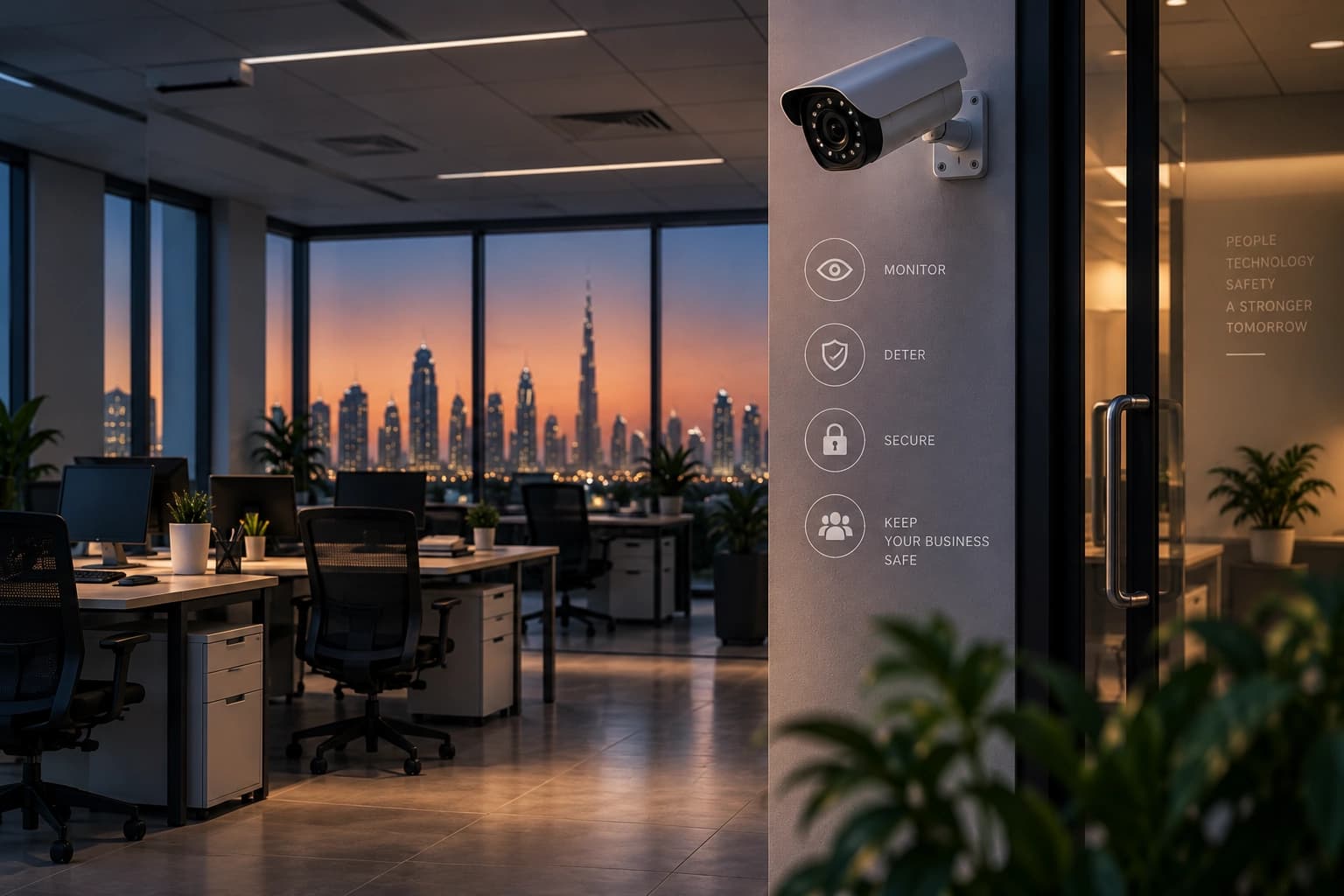
An empty office naturally has less human activity, which can make unusual incidents harder to notice. Without proper monitoring, a business may not know that something has happened until employees return.
Common after-hours risks include:
Unauthorised entry
Theft of equipment or valuables
Vandalism and property damage
Unauthorised access to restricted areas
Suspicious activity around the premises
Fire and smoke incidents
Water leaks or other environmental problems
The goal is not simply to install security equipment. Businesses should create a complete approach that combines prevention, monitoring, detection, and response.
CCTV is one of the most practical ways to maintain visibility when an office is closed. Properly positioned cameras can monitor important areas and provide recorded footage that can be reviewed when necessary.
Businesses can consider CCTV coverage for:
Main entrances and exits
Reception areas
Parking areas
Storage rooms
Warehouses
Loading and delivery areas
Corridors and restricted spaces
CCTV & Security Systems Uae can help businesses improve visibility across their premises and monitor activity outside normal working hours.
Camera placement is particularly important. A large number of cameras does not automatically mean better security. The system should be planned around the property's layout, important assets, entry points, lighting conditions, and potential blind spots.
Modern surveillance systems can provide more flexibility than traditional cameras. Depending on the system and configuration, authorised users may be able to view live footage or access recordings remotely.
This can be useful for business owners and managers who are travelling or away from the UAE.
For example, if an unusual event occurs outside business hours, an authorised person may be able to check the camera feed remotely and decide whether further action is required.
Remote monitoring does not replace professional security or emergency services, but it can provide additional visibility and help businesses stay informed about what is happening on their premises.
CCTV helps businesses see what is happening, but access control helps determine who can enter in the first place.
Businesses can use access control solutions such as:
Access cards
PIN-based entry
Biometric authentication
Electronic door locks
Visitor management systems
Access permissions should be based on employee responsibilities. Sensitive areas such as server rooms, storage spaces, and management offices may require more restricted access.
It is also important to remove or update access permissions when employees, contractors, or temporary workers no longer need access.
Technology should always be supported by basic physical security.
Before closing the office, staff should check all possible entry points. This includes main doors, emergency exits, windows, loading areas, garages, and service entrances.
Ground-floor windows and less visible entrances may require additional attention. Businesses should also make sure emergency exits remain compliant with applicable safety requirements while being monitored appropriately.
A simple closing procedure can prevent many avoidable security issues.
Lighting plays an important role in after-hours security. Dark entrances, parking areas, pathways, and external spaces can make it more difficult to identify activity.
Businesses can consider appropriate lighting around:
Main entrances
Parking areas
Building perimeters
Loading zones
Walkways
Service entrances
Scheduled or motion-activated lighting can be useful in suitable locations. Good lighting can also support CCTV performance by providing better visibility during nighttime recording.
Not every area inside a business has the same security requirements. Businesses should identify areas where unauthorised access could cause significant financial or operational damage.
These may include:
Servers and networking equipment are critical to business operations. Restricted access and suitable CCTV coverage can help protect these areas.
Businesses often handle confidential contracts, financial records, customer information, and other sensitive documents. Access should be limited to authorised personnel.
Stock, tools, equipment, and valuable materials may require additional monitoring, especially outside normal working hours.
Retail businesses and other organisations that handle cash should consider stronger access controls and appropriate surveillance around relevant areas.
Business security is not limited to theft and unauthorised entry. An empty building can also be affected by fire, smoke, water leaks, temperature changes, or equipment problems.
Depending on the property and business requirements, suitable detection and monitoring systems can help identify certain problems earlier.
For example, a fire or smoke detection system can provide an early warning, while environmental monitoring can help identify unusual conditions in areas containing sensitive equipment.
Businesses should ensure that these systems are properly maintained and integrated into their overall emergency response procedures.
A simple checklist can make office closing procedures more consistent.
Before leaving the premises, employees can check:
Are all required doors and windows secured?
Are restricted areas properly locked?
Are CCTV cameras operational?
Is recording working correctly?
Are alarms activated?
Is the required security lighting switched on?
Are valuable items properly secured?
Are emergency contacts available?
Are unnecessary devices switched off safely?
The checklist can be adapted to the specific requirements of the business.
For larger offices and warehouses, assigning responsibility to specific employees can make the process more reliable.
Installing a CCTV or access control system is not the end of the security process. Equipment needs regular inspection and maintenance to ensure it continues to work as expected.
Businesses should periodically check:
Camera positioning
Video quality
Recording functionality
Storage capacity
Network connectivity
Alarm systems
Access permissions
Door locks
Security lighting
A camera that has stopped recording or an access card that still works after an employee leaves can create an unnecessary security gap.
Regular maintenance can help identify these problems before they become serious.
Digital security is also important when managing modern surveillance systems. Remote CCTV platforms, access control systems, and other connected devices should be protected from unauthorised access.
Businesses should use strong credentials, limit system access to authorised personnel, and remove unnecessary user accounts.
Where supported, additional authentication and appropriate network security controls can provide another layer of protection.
Security system access should also be reviewed periodically to make sure only the right people can view footage or change system settings.
Security planning becomes especially important when a business will remain closed for several days.
Before a long closure, management should confirm that CCTV, alarms, access control, lighting, and other important systems are functioning correctly.
It is also useful to make sure responsible personnel know how to respond if an alert is received.
For businesses operating in the UAE, this can be particularly relevant during extended public holiday periods or company-wide vacations when premises may remain empty for several consecutive days.
There is no single security system that works for every business. A small office, retail store, warehouse, and large commercial property can have very different requirements.
Before choosing a solution, consider:
The size and structure of the premises will influence the number and type of cameras and access points that need monitoring.
Identify what needs the most protection. This could be customer areas, stock, IT equipment, documents, cash, or restricted rooms.
If managers frequently travel, remote monitoring may be an important requirement.
Businesses should consider how much footage needs to be retained and how recordings will be stored and accessed.
Security systems require ongoing technical support. Choosing a provider that can assist with maintenance, troubleshooting, and upgrades can help keep the system reliable.
Some businesses invest in security equipment but overlook the wider system.
Common mistakes include installing cameras without considering blind spots, failing to maintain equipment, giving too many people system access, ignoring lighting, and not reviewing access permissions.
Another common issue is assuming that CCTV alone provides complete protection. Cameras are valuable, but they are most effective when combined with access control, alarms, physical security, and appropriate monitoring.
Use a combination of CCTV, access control, alarms, secure entry points, lighting, and regular security checks. The right combination depends on the business and property.
Many modern CCTV systems allow authorised users to view live or recorded footage remotely, depending on the system configuration and connectivity.
CCTV provides important visibility, but it should be part of a broader security strategy. Access control, alarms, physical security, lighting, and regular maintenance can provide additional protection.
Businesses should regularly test cameras, recording, storage, connectivity, and other security components. The appropriate maintenance schedule depends on the system and operating environment.
Combining access control with CCTV can provide both visibility and controlled entry. This is particularly useful for restricted areas and businesses with valuable equipment or sensitive information.
An empty office should not mean an unprotected business. UAE companies can improve after-hours security by combining CCTV surveillance, access control, alarms, lighting, physical security, and regular maintenance.
The best security strategy depends on your business type, property layout, location, assets, and specific risks. A properly planned system can provide better visibility, control access, and help responsible personnel respond to potential incidents more effectively.
Whether you operate an office in Abu Dhabi, a retail business in Dubai, a warehouse in Musaffah, or another commercial property across the UAE, investing in a suitable security solution can help create a safer and more controlled environment.
Looking to improve your business security? Al Katef IT Solutions provides CCTV and security solutions for UAE businesses, helping organisations strengthen surveillance, access control, and overall workplace security.
Talk to our team about how we can help your business implement the strategies discussed in this article.